
Fifteen years of stagnation at the Vienna Commercial Court favor a Moscow billionaire clan.
Since 2011, the Vienna Commercial Court has been home to a high-stakes Russian economic thriller. What is officially conducted as a complex civil lawsuit is, upon closer inspection, a prime example of a Western constitutional state’s powerlessness against Russian tactics of attrition. While the Republic officially preaches sanctions, the domestic judiciary has been providing sanctioned actors with a luxurious stage for a legal war of nerves for over 5,400 days.
Power, Fertilizer & Billions
The Trigger: At the center is the Russian fertilizer giant PhosAgro, a global market leader whose products are exported to over 100 countries. The company is one of the most important sources of income for the Kremlin. Behind the giant stands the Guryev clan:
- Andrey Guryev Senior: Founder, former CEO, and long-time Senator in the Russian Federation Council. He is considered a close Putin confidant and has been personally sanctioned by the US and the UK. However, he is not on the EU list.
- Andrey Guryev Junior: The son took the helm at PhosAgro in 2013. Since March 2022, he has been on the EU sanctions list and stepped down from operational roles in the company that same month.
- Vladimir Litvinenko: The Rector of the St. Petersburg Mining University and co-owner of PhosAgro is considered the man who supervised Putin’s doctoral thesis. A key strategist in the background.
About PhosAgro: It is a Russian company and one of the world’s leading manufacturers of phosphate-based fertilizers. Its products are sent to over 100 countries. The most important markets outside of Russia and the CIS are Latin America, Asia, and Europe.
Opposing them is the Vienna-based company Uritrans with its managing directors Serguei Melnikov and Simon Pevzner.
And now: What is this legal thriller about?
The Forced Deal
The Scenario: The origin of the dispute dates back to 2006. At that time, Uritrans held shares in the Russian fertilizer company VMU and sought a merger that would have increased its stake to over 35 percent.
However, on May 25, 2006—just one day before the decisive general assembly—Uritrans was placed under massive pressure by PhosAgro.
In an atmosphere of coercion, according to Uritrans, they were forced to sign four contracts, including a so-called call option. This gave PhosAgro the right to buy back further shares at a price determined by PhosAgro itself.
Between the lines: Uritrans signed explicitly „under protest,“ as PhosAgro would otherwise have blocked the merger necessary for survival.
According to Uritrans, PhosAgro assured them twenty years ago that they would not exercise these options, as they were only needed for formal reasons for the general assembly. Today, PhosAgro is using precisely these contracts to claim millions in damages before the Vienna Commercial Court.
But why can a Russian company, despite sanctioned oligarchs, even litigate at the Vienna Commercial Court?
The 48.5 Percent Trick
The fact that PhosAgro is still allowed to sue in Vienna and export worldwide is due to a legal subtlety that could be described as „sanctions chess.“ The Guryev family officially holds only 48.5 percent of the shares in the company—exactly 1.5 percent below the magic 50 percent threshold at which EU sanctions would automatically affect the entire company.
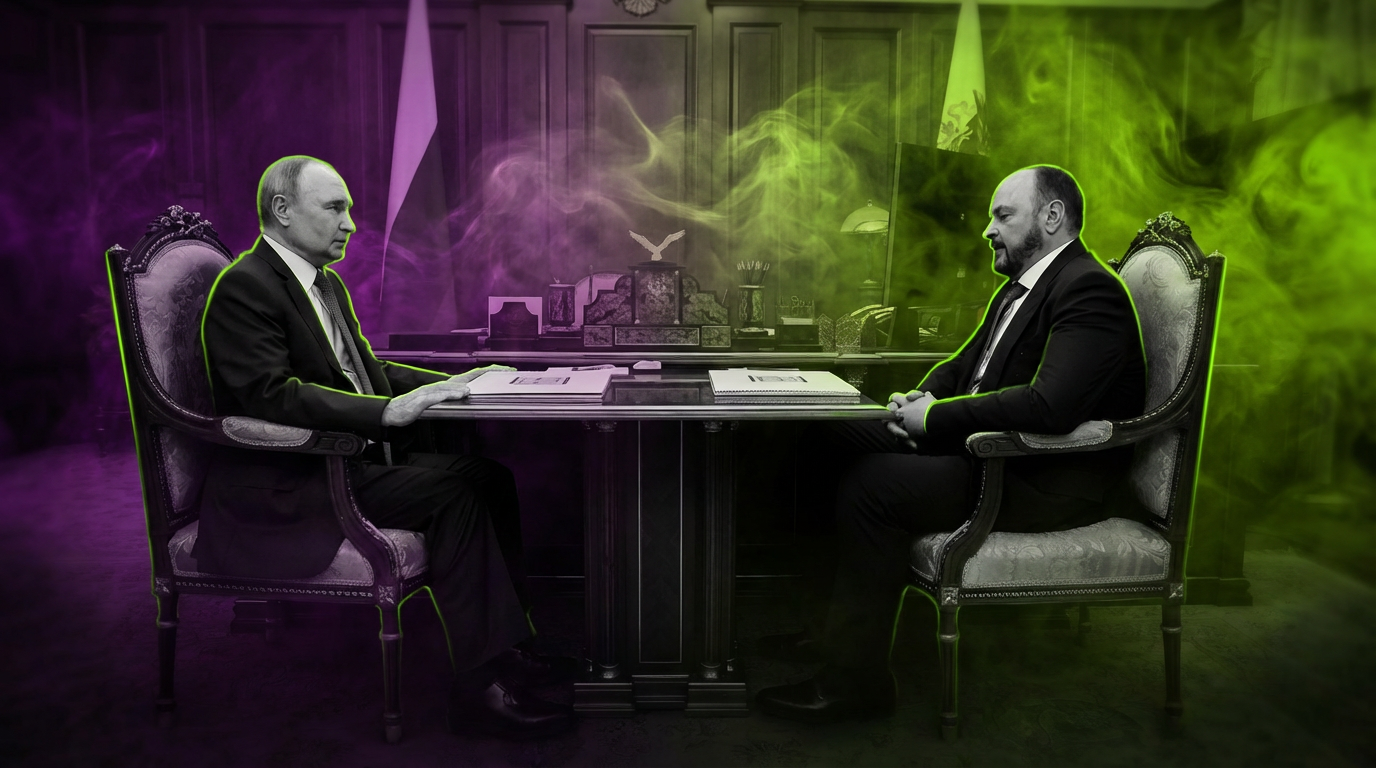
Meeting with Putin: The formal ownership limit is a loophole that plays into PhosAgro’s hands. How close the connection to the „very top“ is was only shown on July 17, 2025: While the trial in Vienna continued to drift along, Vladimir Putin officially received the junior oligarch Andrey Guryev in the Kremlin. Guryev appeared in his capacity as President of the Russian Fertilizer Producers Association (RFPA). Putin and Guryev called a planned EU ban on Russian fertilizer imports „ridiculous“ and „destructive.“ Russia supplies 30% of EU imports (5.5 million tons out of 17 million).
Powerlessness of the Judiciary
The schizophrenia is complete: Austria supports international sanctions but allows the same sanctioned clan to use the Vienna Commercial Court as a legal playground. The judiciary invokes judicial independence and the complexity of the case. In practice, this means:
- Russian witnesses testify comfortably via video from the Empire Tower in Moscow.
- The court allows itself to be overwhelmed by a flood of documents and Russian experts.
FoB Inquires
Who says what: The editorial team confronted the Ministry of Justice, the Vienna Commercial Court, and the lawyers of both parties with the sluggish duration of the proceedings. While the Ministry and the lawyers remained silent, the Vienna Commercial Court defensively justified the 15-year duration: „If a proceeding takes a long time, it does not mean that work is not being done swiftly,“ according to the official statement. They pointed to the complexity of cross-border issues and emphasized that even clarifying jurisdiction could take over a year. A period that, according to the court, is „consistently not unusual.“
A fundamental problem: The judiciary parries the accusation of attrition by referring to the „right to be heard“ and judicial independence. That witnesses can testify comfortably via video from the Moscow Empire Tower is provided for by law. Whether influence is exerted on them is solely a matter of the judge’s „free evaluation of evidence.“
Particularly explosive: The court admits that there is no legal leverage to terminate „uneconomic proceedings“ ex officio. The decision to stop the trial through a settlement lies solely with the parties.
Why this matters: This is exactly where the Russian strategy comes in. Anyone with an infinite amount of money, time, and backing from Moscow can keep the Austrian constitutional state busy in an endless loop of briefs, expert opinions, and witness hearings until the opponent gives up financially and psychologically.
This has long since ceased to be just a commercial dispute between PhosAgro and Uritrans. It is about whether a Western constitutional state is able to pull the emergency brake when its own infrastructure becomes a tool for hybrid influence. Should PhosAgro ultimately win this trial, the Russian state budget—and thus the Kremlin’s system—would benefit directly. A similar precedent is currently being litigated in Great Britain.
Auf Deutsch: Putins Dünger-Oligarch narrt Justiz